Starting a business often means making careful decisions with limited time and money. In the early days, a laptop, a reliable internet connection and a quiet place to work may be enough. But as customers arrive, projects increase and new employees join, the way you work begins to change.
For founders building a business in Hong Kong, choosing a workspace is more than finding a desk. It is about balancing business credibility, operating costs, team productivity, client access and room for expansion. The right choice can support your next stage without locking you into an office that is too large, too expensive or unsuitable for your working style.
The good news is that a traditional long-term office lease is not the only option. A virtual office, coworking space, serviced office or bookable meeting room can each serve a different purpose. The key is to match the workspace to the stage your business is actually in.
Table of Contents
- Why Your Office Requirements Change as Your Business Grows
- The Main Types of Office Space in Hong Kong
- Choose Workspace According to Your Business Stage
- How to Choose the Right Hong Kong Office Location
- Calculate the Real Cost of Your Office Space
- What to Look for in a Flexible Office Provider
- Planning for Growth Without Paying for Empty Space
- Why a Business Centre Can Make Growth Easier
- A Practical Office-Selection Checklist
- Find a Workspace That Grows with Your Business
- Explore Flexible Workspace Options with Urban Workspace Hong Kong
- Frequently Asked Questions About Office Space in Hong Kong
1. Why Your Office Requirements Change as Your Business Grows
A workspace that works perfectly for one founder may become inconvenient when the business has five employees. Likewise, a private office may be unnecessary for a company whose team works remotely and meets clients only occasionally.
From working alone to working with others
Solo founders often prioritise affordability and flexibility. They may work from home, use a shared desk or choose a virtual business address in Hong Kong while testing a market. As the business develops, regular collaboration, onboarding, confidential discussions and team meetings can make a dedicated physical workspace more valuable.
From informal meetings to professional client experiences
Early conversations may happen online or in cafés. As your client base expands, you may need a reliable place to hold presentations, interviews, negotiations and planning sessions. A professional meeting room in Hong Kong can provide the right setting without requiring you to maintain a permanent conference room.
From keeping costs low to managing total value
At the beginning, the cheapest desk may seem like the obvious choice. Later, time spent arranging internet, furniture, cleaning, reception, utilities and repairs can become a distraction. It is useful to compare the total cost of occupancy and the time required to manage the workspace—not just the advertised rent.
2. The Main Types of Office Space in Hong Kong
There is no single best workspace for every company. Consider the following formats before deciding how much space and support you need.
Virtual Office: A Professional Presence Without a Full-Time Office
A virtual office in Hong Kong can be a practical starting point for a founder who works remotely, operates across different markets or visits Hong Kong periodically. Depending on the selected plan, a virtual office may provide a professional business address and agreed mail, call or administrative support.
It may suit:
- Solo founders and consultants who mainly work remotely.
- Overseas businesses exploring the Hong Kong market.
- Small companies that need a local business presence without a full-time office.
- Businesses that use bookable rooms when in-person meetings are required.
Check before choosing: Confirm exactly what the package includes, how mail is handled, whether calls are included, what access is available and whether the address is appropriate for your intended company-registration, licensing or regulatory purpose. A virtual office service should not automatically be assumed to satisfy every statutory or regulatory requirement.
Coworking Space: Flexible Working with a Shared Community
A coworking space in Hong Kong gives individuals and small teams access to a shared professional environment. It can be useful when working from home is distracting or when a founder wants a more structured routine and opportunities to connect with other professionals.
It may suit:
- Freelancers, independent professionals and remote workers.
- Startups with a small or hybrid team.
- Businesses that do not need a permanently enclosed office.
- Founders who value shared facilities and a collaborative atmosphere.
Check before choosing: Ask about desk availability, access hours, internet arrangements, phone-call areas, meeting-room charges, guest policies, storage and privacy. A shared environment is not always suitable for confidential calls or work that requires a controlled setting.
Serviced Office: A Dedicated Workspace That Is Ready to Use
A serviced office in Hong Kong is often a natural next step when a business needs a private, consistent place for its team. Serviced offices are generally furnished and supported by shared facilities or services, although the exact inclusions depend on the provider and agreement.
It may suit:
- Startups that have moved beyond a one-person operation.
- Small and medium-sized businesses that need a dedicated office.
- Companies hosting clients, partners or employees regularly.
- Overseas businesses establishing a local operating base.
Check before choosing: Confirm the office capacity, furniture, internet, reception or administrative support, utilities, cleaning, meeting-room access, security, deposit, minimum term, renewal process and exit conditions. Request a written breakdown of what is included and what costs extra.
Meeting Room Rental: Professional Space When You Need It
You may not need a permanent office to meet clients professionally. Meeting room rental in Hong Kong can give your business access to a suitable space for interviews, presentations, team discussions, training or client reviews. Some providers offer short bookings, including hourly or part-day use.
Ask about room capacity, display equipment, video-conferencing facilities, whiteboards, internet access, refreshments, reception support and booking or cancellation rules. Urban Workspace lists meeting facilities with equipment such as an LCD TV or projector, whiteboard, video conferencing and flip chart; confirm the current availability and configuration when enquiring.
| Workspace type | Best suited to | Main advantage | Important consideration |
|---|---|---|---|
| Virtual office | Remote founders and market entrants | Professional presence with lower physical-space commitment | Confirm address use and exact services |
| Coworking space | Freelancers and small, flexible teams | Shared workspace and community | Privacy, desk access and meeting-room rules |
| Serviced office | Established startups and growing teams | Dedicated, ready-to-use workspace | Capacity, contract terms and total monthly cost |
| Meeting room | Businesses with occasional in-person meetings | Professional meeting facilities on demand | Availability, equipment and booking conditions |
3. Choose Workspace According to Your Business Stage
Rather than choosing an office based only on your current headcount, consider how your business operates and what is likely to change over the next 6–18 months.
Stage One: The Solo Founder
When you are validating an idea, building your first customer relationships or working independently, flexibility is usually more valuable than a large private office. A virtual office may help establish a professional presence, while coworking can provide a regular place to work outside the home.
At this stage, ask yourself:
- Do I need a physical desk every working day?
- How often do I meet clients in person?
- Do I need a business address or administrative support?
- Would a shared workspace be sufficient for my daily tasks?
Stage Two: The First Employees
When your first employees join, informal arrangements can become harder to coordinate. A shared workspace may still work well, especially for a hybrid team, but you should evaluate whether everyone can access desks when needed and whether there is enough space for collaboration.
A small serviced office may be worth considering if your team works together regularly, handles sensitive information or needs a consistent base. You can also combine a flexible workspace with bookable meeting rooms if the team is not in the office every day.
Stage Three: A Growing Team
As headcount increases, workspace planning becomes more operational. You may need dedicated workstations, private discussions, onboarding space, storage and a predictable meeting schedule. A private serviced office in Hong Kong can make daily coordination easier while avoiding some of the setup work associated with fitting out a conventional office.
Estimate your realistic peak attendance rather than assuming every employee will be at a desk simultaneously. Review hybrid schedules, visiting staff, contractors and future hires before selecting capacity.
Stage Four: Expansion or a Hong Kong Market Entry
International companies and established businesses entering Hong Kong may need a local presence before they know how large the team will become. A virtual office or smaller serviced workspace can provide a starting point, with the option to reassess as local operations develop.
Think about client accessibility, transport connections, recruitment, business registration needs and whether the location supports the image you want to present. Coordinate workspace decisions with your legal, company-secretarial and compliance advisers where necessary.
4. How to Choose the Right Hong Kong Office Location
Location affects more than prestige. It can influence commute times, employee convenience, client visits, access to suppliers and the way your business is perceived. The best district is the one that supports your actual work and budget.
Consider the people who will use the office
Map where your employees, clients and regular partners travel from. Check nearby MTR stations, bus routes, walking routes, building access and the practical experience of visiting the premises. A central address may be valuable for frequent client meetings, while a more cost-conscious location may be suitable for a team whose work is mostly internal.
Match the building to your business needs
Look beyond the district name. Consider the building's condition, lift access, security, accessibility, visitor arrangements, surrounding amenities and the environment inside the workspace. If clients will visit, consider how easy it is to find the reception and reach the office.
Review the available locations
Urban Workspace identifies the following serviced office locations in Hong Kong:
- Harbour Centre, Tower 2
- Focal Industrial Centre, Block A
- Peninsula Square
Ask the team which workspace types are currently available at each location, what office sizes can be viewed and which facilities are included. Availability, pricing and suitability should be confirmed directly rather than assumed from a location listing.
5. Calculate the Real Cost of Your Office Space
Comparing office options only by their headline monthly price can lead to an incomplete decision. A traditional office may involve separate setup and operating expenses, while a flexible workspace may bundle some services into one fee. Compare like with like.
Costs to include in your comparison
- Recurring workspace fee: Monthly rent, licence fee or membership fee.
- Upfront payment: Deposit, advance payment, setup fee or administration charge.
- Furniture and fit-out: Desks, chairs, partitions, cabling, decoration and equipment.
- Utilities and connectivity: Electricity, air conditioning, internet and telephone services.
- Facilities: Cleaning, reception, printing, pantry access and meeting-room use.
- People and administration: Time spent coordinating vendors, building access, maintenance and office supplies.
- Exit costs: Notice periods, reinstatement obligations, early termination charges and moving expenses.
Compare the cost per person and the cost of flexibility
For a team, calculate the expected monthly cost per regular office user. Then consider whether you are paying for unused desks or facilities. A slightly higher monthly fee may offer better value if it includes services your business would otherwise need to arrange separately. Equally, a bundled package is not automatically cheaper—check its inclusions and limits.
Ask each provider for a written quotation that clearly separates included services, optional extras, taxes where applicable, payment terms and any one-off charges.
6. What to Look for in a Flexible Office Provider
The provider's service and responsiveness can affect your team's everyday experience. Before making a decision, use this checklist:
- Transparent pricing: Are all recurring and one-off charges explained?
- Suitable agreement: Are the term, renewal, notice and exit conditions clear?
- Reliable connectivity: Is the internet suitable for your team's actual workload and video calls?
- Professional support: Is reception, administrative or IT assistance available, and during which hours?
- Meeting facilities: Can you book rooms when required, and are the rates and rules clear?
- Privacy and security: Can confidential calls, documents and equipment be handled appropriately?
- Access and convenience: Do the building and workspace access arrangements suit your schedule?
- Growth options: Can you move to a larger office or a different workspace arrangement if your needs change?
- Service clarity: Is there a named contact for questions, maintenance and day-to-day requests?
7. Planning for Growth Without Paying for Empty Space
It is tempting to rent a larger office in anticipation of rapid hiring. However, forecasts can change. A more measured approach is to select a workspace that meets current needs and understand the practical route to expansion.
Forecast headcount realistically
Prepare a simple 6–18 month staffing forecast. Separate confirmed hires from possible hires, and consider whether employees will work in the office full-time, part-time or on a hybrid schedule. This helps you avoid paying for unused capacity.
Use shared facilities strategically
If your team needs a private office but only holds large meetings occasionally, booking a meeting room may be more efficient than paying for a dedicated conference room every month. Similarly, a hybrid team may need fewer permanent desks than its total employee count.
Ask about expansion before you sign
Do not assume you can automatically move into a larger office later. Ask about nearby office availability, transfer procedures, revised fees, notice periods and whether your existing agreement allows changes. Get any important flexibility commitments in writing.
8. Why a Business Centre Can Make Growth Easier
A business centre can bring workspace and practical business facilities together. Instead of managing every part of an office independently, a company may be able to use a combination of serviced office space, virtual office services, coworking facilities and meeting rooms as its needs evolve.
Urban Workspace Hong Kong presents workspace options for businesses at different stages, from virtual office and coworking arrangements to serviced offices and meeting facilities. Its website also lists amenities and support such as high-speed Wi-Fi, reception service, IT support, VoIP/IPT systems and day-office facilities. Confirm the current availability and terms of each service with the provider.
For founders who are also establishing a Hong Kong company, the website lists business registration, company secretarial, accounting and company maintenance support. These services are separate from choosing a workspace, so discuss the exact scope, responsibilities, fees and statutory requirements before relying on any package.
9. A Practical Office-Selection Checklist
Before arranging a viewing or signing an agreement, make sure you can answer these questions:
- How many people need regular access to the workspace?
- How many desks are required on the busiest working day?
- Do we need a private office, shared desks or only a business address?
- How often will clients, suppliers or candidates visit?
- Which location is convenient for our team and customers?
- What is the complete monthly cost, including optional services?
- What are the deposit, minimum term, renewal and termination conditions?
- Are internet, reception, cleaning and meeting-room access included?
- Can we increase or reduce our space if our plans change?
- Have we reviewed the agreement and any relevant legal or compliance requirements?
10. Find a Workspace That Grows with Your Business
The right office space in Hong Kong should support the way your business operates—not force you into a setup designed for a different company. A solo founder may begin with a virtual office or coworking desk. A small team may benefit from a dedicated serviced office. A business with occasional client meetings may simply need a professional meeting room when required.
As your team grows, review your workspace regularly. Look at attendance, collaboration, client requirements, total costs and your hiring plans. Choose a provider that explains its services clearly and can discuss realistic options for your next stage.
Explore Flexible Workspace Options with Urban Workspace Hong Kong
Whether you are starting independently, building your first team or establishing a presence in Hong Kong, explore workspace options that match your business requirements.
Learn more about serviced offices, virtual offices, coworking space and meeting rooms in Hong Kong, or contact the Urban Workspace team to discuss your preferred location, team size and requirements.
Phone: +852-6553-7375
Email: urbanworkspacehk@outlook.com
Visit Business Center in Hong Kong
Frequently Asked Questions About Office Space in Hong Kong
1. What is the best type of office space for a startup in Hong Kong?
The best option depends on your team size, budget, client-facing needs and growth plans. A virtual office may suit a founder who mainly works remotely, coworking space can suit individuals and small teams, and a serviced office can provide a dedicated private workspace with support services.
2. What is a serviced office in Hong Kong?
A serviced office is a furnished, ready-to-use workspace that commonly includes shared facilities and support services. Exact inclusions, availability, pricing and agreement terms vary by provider and package, so request a written list before committing.
3. Is a virtual office suitable for a new Hong Kong company?
A virtual office in Hong Kong can suit a business that needs a professional business address and agreed correspondence or administrative support without occupying a full-time physical office. Confirm whether the address and services meet the requirements of your intended use, including any company-registration or regulatory requirements.
4. When should a startup move from coworking to a private office?
Consider a private office when your team needs consistent dedicated desks, confidential conversations, secure storage, more control over its working environment or predictable access to the same space. Review actual attendance and growth plans before committing.
5. What should I check before renting office space in Hong Kong?
Compare the full monthly cost, deposit and payment terms, minimum commitment, included services, internet, meeting-room access, business hours, access arrangements, privacy, location, expansion options and exit conditions. Ask for all additional charges in writing.
6. Can I rent a meeting room in Hong Kong by the hour?
Some business centres offer meeting room rental on short bookings, including hourly or part-day arrangements. Check the provider's available rooms, booking duration, capacity, equipment, support and cancellation terms.
7. What is the difference between a coworking space and a serviced office?
Coworking space generally provides access to a shared working environment, while a serviced office usually provides a dedicated private office with facilities and support services. The precise distinction and inclusions depend on the provider.
8. Can my office space change as my team grows?
Flexible workspace providers may offer different workspace types or office sizes, allowing a business to review its setup as its needs change. Confirm transfer options, availability, pricing and notice requirements before signing.
9. Is a serviced office better than a traditional office lease?
It depends on your priorities. A serviced office may reduce setup work and provide shared facilities, while a traditional lease may offer greater control over layout and long-term customisation. Compare total costs, contract terms, fit-out responsibilities and flexibility rather than assuming one option is always cheaper.
10. How much office space does a small team need?
There is no universal figure. Start with the number of people who will be present at the same time, then account for desks, meeting areas, storage, circulation and any privacy needs. Ask to view the actual office layout and check its practical capacity before deciding.
11. What facilities should a small business look for in a business centre?
Useful facilities may include reliable internet, reception support, IT assistance, meeting rooms, printing, telephone services and convenient building access. Prioritise the services your team will genuinely use and confirm whether each is included or charged separately.
12. Does a virtual office provide a physical place to work?
Not necessarily. A virtual office is primarily designed to provide an agreed business address and related services. If you need a desk or private room, ask whether the provider offers coworking, day-office or meeting-room options separately.
Image SEO Details
Recommended image file name: hong-kong-office-space-growing-team.jpg
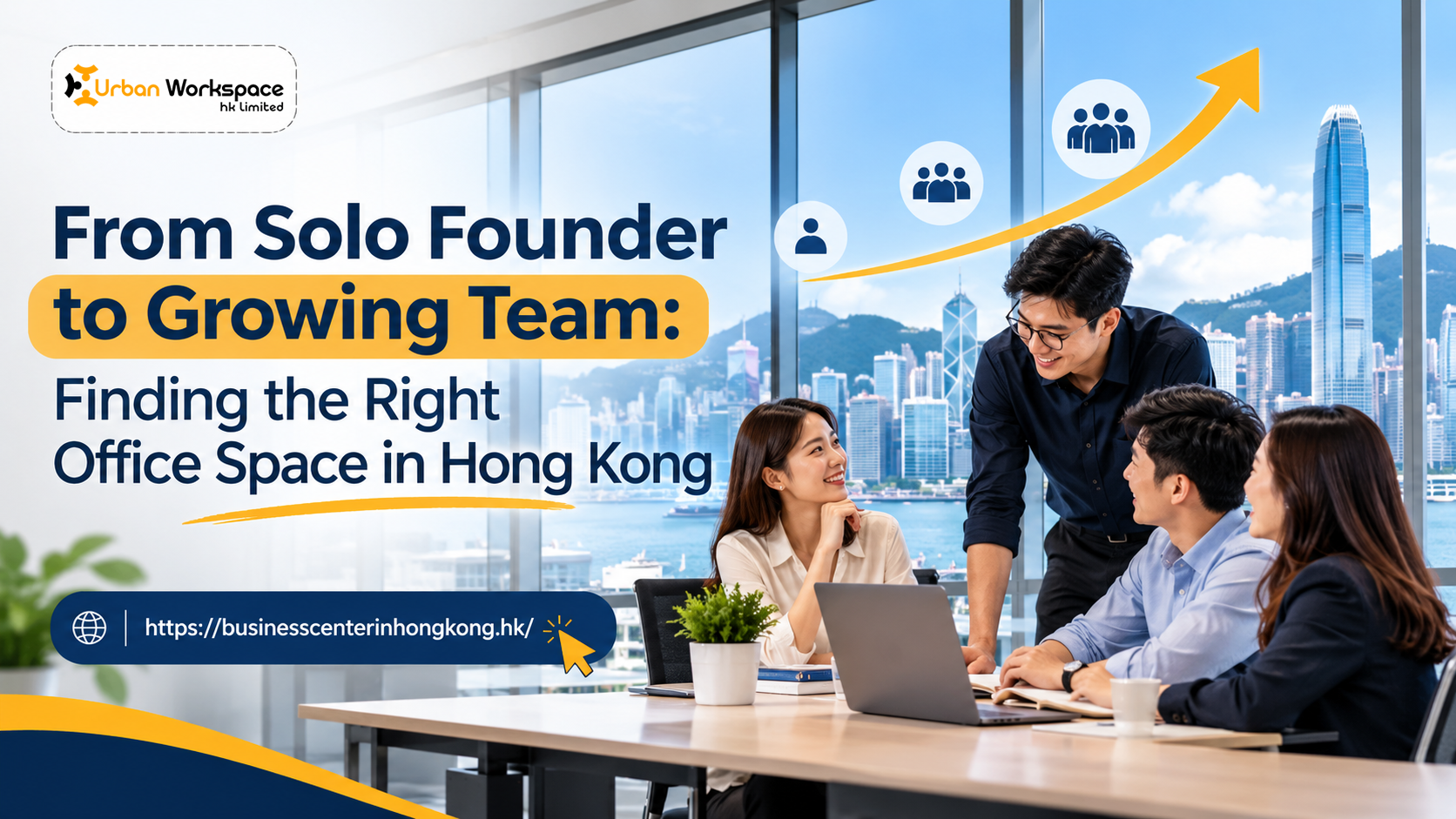
Image alt text: Solo founder and growing startup team working together in a modern Hong Kong serviced office
Image title attribute: Flexible Office Space in Hong Kong for Growing Businesses
Editorial note: Add a relevant, properly licensed featured image before publishing. Set its actual image URL in the Open Graph and Twitter image metadata. The canonical URL above uses the proposed article slug; update it if the final published URL differs.